
How to Check Criminal History in Vallejo
Begin with the kind of Vallejo criminal record you need. A police report comes from Vallejo Police Department. A recent custody record belongs to the Solano County jail system. Once the District Attorney files a complaint, the case belongs to the Superior Court of California, County of Solano. A statewide fingerprint-based summary of your own record comes from the California Department of Justice, not from a city counter.
Names alone can point to the wrong person, so collect the report number, case number, booking date, or date range when possible. Use this order to keep the search narrow:
- Ask Vallejo Police Department for a report copy or use its public-records request channel.
- Review the daily incident log only for recent police activity and call status.
- Check Solano jail records when a Vallejo arrest resulted in county booking.
- Search the Solano Superior Court portal for filed charges, hearings, and outcomes.
- Use California DOJ Live Scan only to review your own statewide criminal-history summary.
The broader Solano County criminal history overview explains the county and state layers in more depth. Vallejo sources remain the right first stop for city police documents.
Vallejo Police Records at Amador Street
Vallejo Police Department is at 111 Amador Street. Its Records Section handles report requests, ticket sign-offs, local background checks, vehicle releases, and general police information. The listed Records telephone number is 707-648-4491, with fax service at 707-648-4490. These services make the unit the practical starting point when the requested Vallejo criminal history item began as a city police contact.
The department lists lobby hours from 9:00 a.m. to 5:00 p.m., Monday through Thursday. It is closed Friday through Sunday and on holidays. The non-emergency number is 707-648-4321, while the Watch Commander can be reached at 707-648-5291. Those lines serve different needs. The records line is best for an existing report; non-emergency dispatch concerns current police service; the Watch Commander is an operational contact, not a substitute for a records request.
Vallejo Police Records Section
111 Amador Street
Vallejo, CA
707-648-4491
Monday-Thursday, 9:00 a.m.-5:00 p.m.
Two Vallejo Police Request Paths
Vallejo separates ordinary report-copy requests from broader California Public Records Act requests. Its police report page links to a secure Coplogic request service for a copy of a report. That route fits a known incident when the requester can identify the report or event. Broader requests for city documents, photographs, emails, texts, video, or data go through Vallejo NextRequest.
| Vallejo channel | Best use | Result |
|---|---|---|
| Coplogic report request | A known police incident | Request for a report copy |
| NextRequest | Broader city records and data | Tracked public-records request |
| Records Section | Questions, releases, sign-offs | Staff direction or service |
Choosing the right channel can prevent delay. A request that asks NextRequest for a court disposition is misdirected because Vallejo does not hold the Superior Court file. Likewise, the court clerk does not replace the police custodian for an incident narrative or city-held video.
The Vallejo Police Department
The Vallejo Police Department creates the first layer of many city criminal records. Dispatch activity, officer reports, traffic collision records, citations, and arrest reports can begin there. That does not mean every file is open in full. Active-investigation facts, protected victim information, juvenile material, and other confidential details may be withheld or redacted under California law.
The department homepage identifies Chief Jason Ta and provides its emergency, non-emergency, lobby, and Watch Commander contacts. These details help a requester reach the correct part of VPD, but emergency lines should never be used for a historical records search. Ask Records what identification, authorization, or report details are needed before visiting. A clear request should describe an existing record, not ask staff to research a person across unrelated files.
The first successful Vallejo source image in the manifest comes from the official VPD homepage.
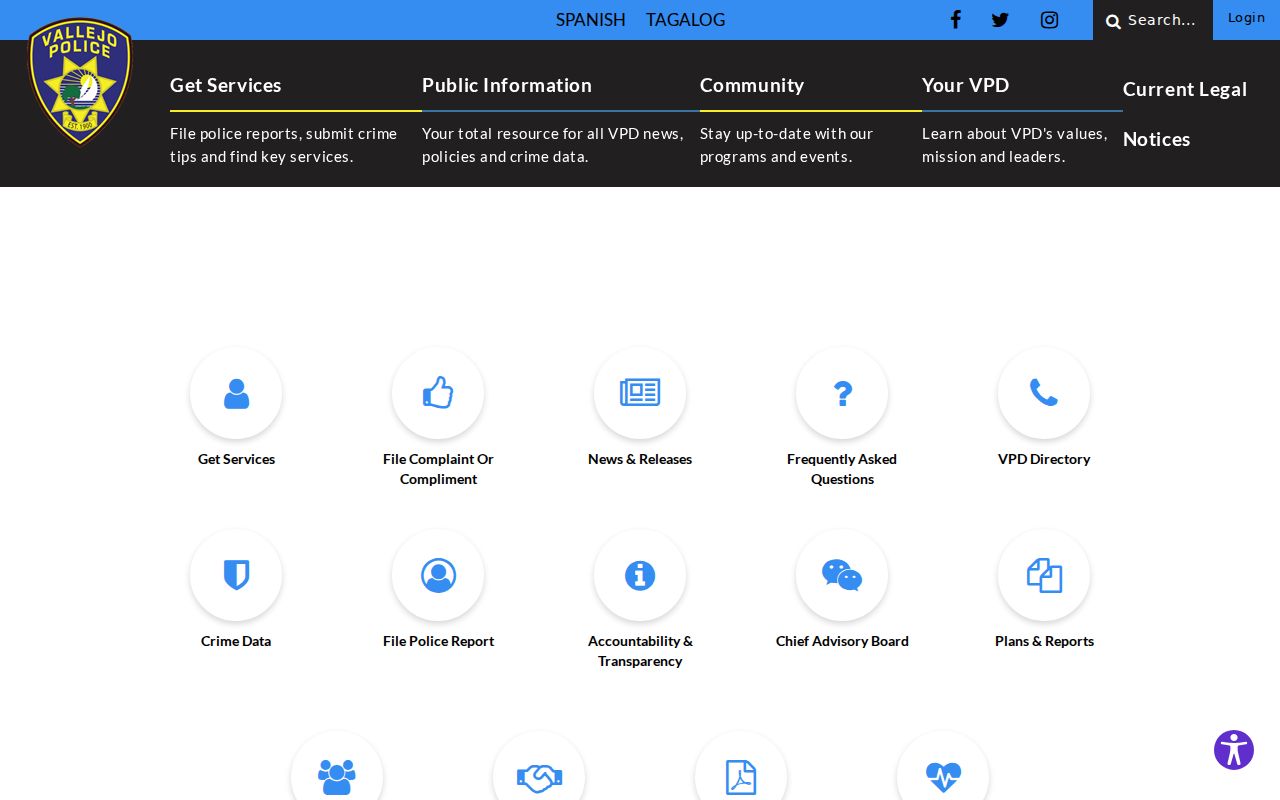
The captured page anchors the local police contact path used for Vallejo report and records questions.
Vallejo Incident Log Is Not History
VPD says it responds to about 58,000 incidents of all kinds in a typical year, or roughly 4,800 per month and 160 per day. Its daily incident log gives a view of that call load. Yet a logged incident is not proof of an arrest, charge, or conviction. It may record a call for service that did not lead to a crime report at all.
The log can mark an event as “Pending” when officers have not responded by posting time. Some incidents take hours or longer to receive a response. That makes the log a useful timing clue, but a poor substitute for Vallejo criminal history. Confirm a completed police record with VPD, a booking with Solano custody sources, and a filed charge with the court. Each later record answers a different question.
Note: A Vallejo incident entry describes police activity, not a judicial finding or a complete account of what later occurred.
Arrests and Bookings in Vallejo
Vallejo officers create the arrest report, but people booked after a city arrest enter Solano County custody records. No official city jail lookup was identified for Vallejo. The county inmate locator and seven-day jail booking logs therefore provide the public custody layer. The booking log covers people arrested and booked into Solano County jail during the preceding seven days and refreshes at midnight in 24-hour groups.
A booking entry may show an arresting agency, booking number, admitted date, custody site, listed charges, holds, and release status. It does not show the final prosecutorial decision. Charges at intake can change, and a booking can appear before the District Attorney files a case. For a full county-level explanation, use the Solano County arrest history resource.
When a recent Vallejo arrest does not appear where expected, first confirm spelling and booking date, then contact the county custody line. Next check the Superior Court after time has passed for filing. Do not treat absence from one database as proof that no event occurred.
Vallejo Criminal Case Prefixes
Solano Local Form 4021 supplies a valuable Vallejo search clue. Criminal cases from Benicia or Vallejo generally begin with V, VC, or VCR. Those prefixes distinguish the Vallejo-side filing stream from the F, FC, and FCR prefixes associated with Fairfield, Suisun City, Vacaville, Dixon, and Rio Vista.
- V, VC, or VCR
- Prefixes used for criminal cases arising from Vallejo or Benicia.
- Case number
- The court identifier that usually gives the fastest portal result.
- Disposition
- The current or final court outcome, such as pending, dismissed, acquitted, or convicted.
- Booking number
- A custody identifier, not the same as the Superior Court case number.
Searchers often mistake a police report number or booking number for a court case number. Keep each identifier with its issuing office. If no case number is known, the Solano portal permits a name or filing-date search after account registration.
Vallejo Municipal Court Records
Vallejo has no separate municipal criminal court. California unified its trial courts, so city criminal and traffic matters route to Solano Superior Court. The local branch is the Solano Justice Building at 321 Tuolumne Street, Vallejo, with a listed telephone number of 707-561-7880. Calling a supposed Vallejo municipal court would send a requester toward an office that does not exist as a separate criminal tribunal.
| Court Name | Superior Court of California, County of Solano, Vallejo Branch |
|---|---|
| Case Types Heard | Criminal and traffic matters routed through the county Superior Court system |
| Case Lookup Channel | Solano Superior Court Public Portal or Criminal Division clerk |
| What the File Shows | Filed charges, hearings, docket entries, disposition, sentence, and available copies |
| Copies & Fees | Clerk search may cost $15 if over ten minutes; copies are $.50 per page or side; certification is $40 per document |
Portal data may lag the most recent filing and is not the official record unless electronically certified. A certified copy must come from the correct court division.
Vallejo Justice Building Record Counter
The Vallejo Criminal Division accepts Local Form 4021 by mail or at the counter. The form requests the requester’s contact details, case number if known, name to search, date of birth, approximate filing period, documents wanted, and whether certification is needed. A self-addressed stamped envelope supports a mailed response.
Records search hours are 8:00 a.m. to 3:00 p.m., Monday through Friday except holidays. The court requires government-issued photo identification and limits requests to five cases per person each day. A $15 name-search fee applies when research exceeds ten minutes. These rules belong to the county court record, even though the Vallejo counter sits inside the city.
The distinction matters most when someone has a VPD report but wants to learn the result. Police can confirm their own record-release process. Only the court file shows what prosecutors filed and what the judge later ordered.
Where Vallejo Records End Up
A Vallejo event can create several connected records. VPD writes the incident or arrest report. Solano County creates custody data after booking. The District Attorney decides whether to file a complaint, and the Superior Court then creates a case docket. Arrest fingerprints and later dispositions may reach the California DOJ repository.
Record flow: Vallejo Police Department › Solano County jail and Superior Court › California Department of Justice
The flow is not instant, and no layer fully replaces another. Recent activity may exist only at VPD or in county booking data. A later court file may show reduced or dismissed charges that the original booking cannot reflect. California DOJ’s statewide summary is not open to an arbitrary public name search. A person may request their own record review through authorized Live Scan service.
Vallejo NextRequest Record Tracking
The successful portal capture assigned to Vallejo comes from the official Vallejo NextRequest form.
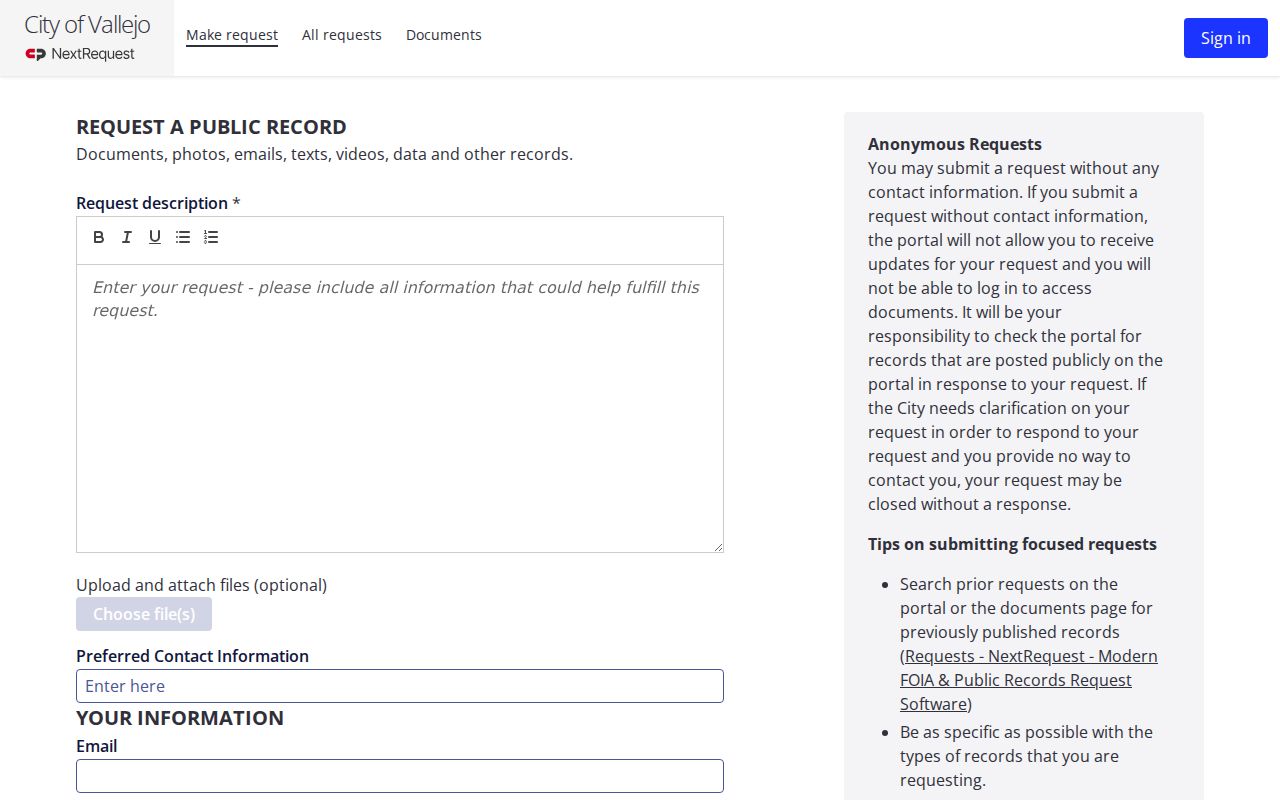
The portal gives broader city-record requests a trackable route apart from the police report-copy workflow.
A focused request should identify a date range, department, incident or report number if known, and the specific record sought. Asking for every record tied to a name may require clarification and can sweep in protected material. NextRequest also does not override statutory limits. Vallejo may redact or withhold exempt information while still producing separable public portions.
When Vallejo Records Leave VPD
Use VPD for what officers or city systems created. Use the county jail for custody, and use Solano Superior Court for the criminal case. This division is especially important after arraignment. A police report can describe probable cause and the initial allegation, while the court file records the filed complaint, pleas, motions, and outcome.
For older or corrected information, compare the sources rather than assuming one is wrong. A dismissal entered by the court may not erase the incident report. A booking charge can differ from the filed charge. A DOJ summary may need a subject-initiated correction if a disposition was not matched. Bring the relevant case or booking identifiers to the custodian that can fix its own record.
Public Access Rules for Vallejo Records
The California Public Records Act governs requests for disclosable Vallejo agency records. It generally requires an agency to decide within ten days whether a request seeks records it can disclose, with a possible extension of up to fourteen days for unusual circumstances. That deadline is a determination period, not a guarantee that all copies arrive within ten days.
Police and court access also depend on subject-specific rules. Active investigations, juvenile information, confidential victim data, and sealed records may be restricted. California DOJ criminal-history summaries have separate limits and are not a general public name-search product.
Key Statutes:
Government Code section 7922.535 sets the CPRA determination period and unusual-circumstances extension.
Penal Code section 11105 restricts dissemination of California summary criminal history.
Penal Code section 13300 limits local summary criminal-history disclosure while recognizing specified recipients, including the subject.
Note: Ask the record-holding office about redactions or review options when a Vallejo response omits material you expected to receive.